
Ergonomic Standards Still a Threat to Manufacturers
Synopsis
Details
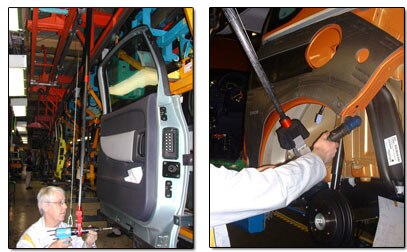
Even during a slow economy, manufacturers must still take all necessary precautions to ensure that their workers stay protected from injuries and disorders resulting from the repetitive use of improper manufacturing processes. Fortunately, by initiating preventative practices and selecting ergonomically designed tools, employers can help lessen their exposure to citation and liability.
A complicated and costly issue
Ergonomics is the science of fitting job functions to the physical capabilities of the human body. Without proper ergonomics on the production floor, employees can be subject to musculoskeletal disorders when a mismatch arises between the physical capacity of workers and the physical demands of their occupation. Jobs that involve reaching, bending over, using continuous force, working with vibrating equipment and doing repetitive motions pose a particular risk for developing injuries and disorders.
To protect workers from injuries caused by over-extension, repetitive motions, and unnatural postural positions, OSHA has traditionally relied on existing powers to issue monetary fines to employers. The General Duty clause, Section 5, paragraph (a) (1), of the OSHA Act of 1970 states that an employer is responsible to provide a safe and healthy workplace for their employees. Absent a specific standard, such as in the case of ergonomics, OSHA can still cite an employer using that section.
Not only is the federal government empowered to cite manufacturers, but also Section 18 of the Act encourages individual states to develop and operate their own job safety and health programs. Aside from the threat of fines from federal and state agencies, manufacturers also must bear the brunt of increasing worker's compensation costs and man-hour production losses. Manufacturers have much to gain by assuming a proactive position. Reducing worker fatigue can improve both morale and production line consistency while reducing absenteeism, and lowering worker's compensation costs.
To protect workers from injuries caused by over-extension, repetitive motions, and unnatural postural positions, OSHA has traditionally relied on existing powers to issue monetary fines to employers. The General Duty clause, Section 5, paragraph (a) (1), of the OSHA Act of 1970 states that an employer is responsible to provide a safe and healthy workplace for their employees. Absent a specific standard, such as in the case of ergonomics, OSHA can still cite an employer using that section.
Not only is the federal government empowered to cite manufacturers, but also Section 18 of the Act encourages individual states to develop and operate their own job safety and health programs. Aside from the threat of fines from federal and state agencies, manufacturers also must bear the brunt of increasing worker's compensation costs and man-hour production losses. Manufacturers have much to gain by assuming a proactive position. Reducing worker fatigue can improve both morale and production line consistency while reducing absenteeism, and lowering worker's compensation costs.
The availability of ergonomically optimized devices puts all manufacturers on notice that they have the means to meet the "general duty" standard imposed by the U.S. Department of Labor. Conceivably, if someone used a tool repeatedly and developed carpal tunnel syndrome as a result, and if there was a way to change that tool to improve the way that employee was having to work with that tool, yet OSHA re-inspected and the change was not made to correct the problem, then OSHA could cite the employer.
An ergonomic mindset helps ensure safer conditions
Besides the proper selection of ergonomically correct tools and workstations, manufactures should adopt enterprise-wide programs that increase the awareness of ergonomics within administrative offices as well as on the production floor.
A successful ergonomic system incorporates employee participation that includes discussion across all levels and directions of an organization. It's recommended to avoid the one-size-fits-all approach. Every ergonomic concern requires its own evaluation, ideally performed by a person competent in such issues. When indicated, control measures should be designed to eliminate ergonomic stresses specific to the results of the evaluation. Finally, effective follow-up mechanisms must be provided.
- Form a permanent safety committee
- Perform a job safety analysis for every job
- Perform routine inspections, even if no hazards have been reported
- Immediately correct any deficiencies; and conduct an accident investigation for each incident, even "near misses."
Ergonomics is more than just treating a stress injury as an isolated occurrence," advises Brad Mountz. "If you have an operator who complains of a sore wrist, numb fingers or tired shoulders, then resolving just that individual's problem is a very short-sighted solution. Eventually, every operator doing that same or similar job is going to experience the same symptoms. You might as well solve the problem across the board."
The productivity bonus
An organizational mindset that embraces the prevention of ergonomic injuries does more than decrease exposure to government fines and worker's compensation cost increases; it can benefit the productivity of a manufacturer.
"It's important to keep the big picture in mind," emphasizes Mountz. "Look at your operators as proponents of your business. Anything you can do to make them comfortable will improve the productivity of your business in the long run."
Prevention of ergonomic injuries now an economic necessity
Manufacturers wishing to survive in the coming years must fully embrace preventative measures to ergonomic injuries. The issue is not going away. Fortunately, efforts to reduce injuries are often rewarded with increases in the bottom line.
Under such light, manufacturers can view ergonomic standards as a boon, not bane. Eliminating ergonomic hazards increases productivity, quality, profits, and the country's ability to compete on a global level.
Mountz EZ-Glider torque arms are designed to improve production and quality control during the assembly process. The EZ-Glider helps remove the operator's influence in the assembly process and strengthens quality control. The effortless handling of the torque arm provides comfortable tool operation and increased production.
Mountz also offers durable tool balancers that provide easy handling for operators that work with tools for long, continuous hours. The balancers allow tools to be positioned over the work station for comfortable operation and can be used with pneumatic, electric, hydraulic or other tools. Mountz offers an assortment of ergonomic tool balancers.
Contact Us
Mountz has a team of application specialists ready to assist!
Featured Blog Posts
Related Posts

Focal Learning Center Heading
Lorem ipsum dolor sit amet, consectetur adipiscing elit, sed do eiusmod tempor incididunt ut labore et dolore magna aliqua. Ut enim ad minim veniam, quis nostrud exercitation ullamco laboris nisi ut aliquip ex ea commodo consequat. Duis aute irure dolor in reprehenderit in voluptate velit esse cillum dolore.
Call a Specialist
Overhead Crane Repair Services Rely on Pro Torque Tools
Lorem ipsum dolor sit amet, consectetur adipiscing elit. Duis aute irure dolor in reprehenderit in voluptate velit esse cillum dolore.
Chat with a Specialist